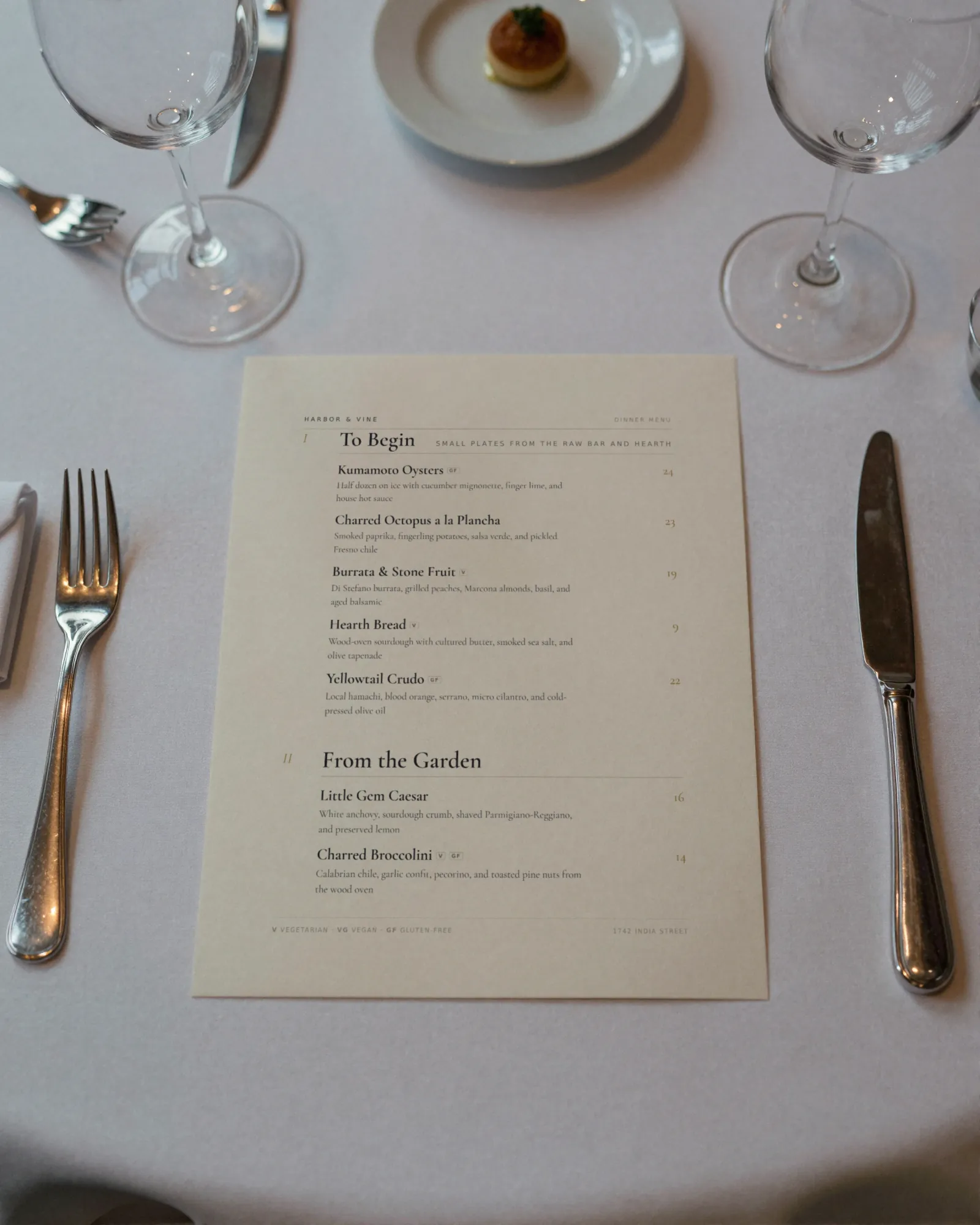
The date and the clock
New Year’s Eve 2026 is a Thursday, and New Year’s Day 2027 is a Friday and a federal holiday, so plenty of your guests will not be working the next morning. It comes exactly one week after Christmas Day, which means the Christmas menu, the fish order, and the printing all run into it. Plan the two nights on one sheet.
The one decision: one seating or two, and what each one costs. A common split is an early seating, around 5:30 or 6:00, that ends by 8:30, and a late seating from about 9:00 that runs through midnight with a toast. The early guest wants a good dinner and to be home by ten. The late guest wants the countdown in your room. They are two menus at two prices.
Bookings open after Thanksgiving, alongside Christmas. Have both menus and both prices final by the end of November, and lock the dishes when the product orders go in, around ten days out.
Timeline: six weeks out to the morning after
The New Year’s-specific steps are below. The general work of changing a menu is in the seasonal menu changeover checklist.
| When | Kitchen | Bar | Front of house | The menu |
|---|---|---|---|---|
| Six weeks out (mid November) | Decide the seatings. Draft the early menu and the late one. | Choose the midnight pour, and a zero-proof one. | Set seating times, turn time, and the booking cutoff. | Build two menus, early and late, both hidden. |
| Four weeks out (end of November) | Cost a guest for each seating. | Price the pairing and the bottle list for the night. | Open bookings with both prices. | Publish both and send each link with its confirmations. |
| Two weeks out | Order the caviar, the lobster, the beef. | Order the sparkling wine by the case. | Plan the midnight: who pours, when. | Proof and print both menus on different stock or color. |
| December 30 | Prep the courses that hold. | Chill the toast. Count the glasses. | Confirm every booking. | Fix anything the delivery changed. |
| The night | Early seating out by 8:30. | Pour the toast at 11:55. | Swap the table tents between seatings. | Hide what runs out. |
| New Year’s Day | Count the leftovers. | Count the empties. | Everyday menus back on the tables. | Hide both menus; start Dry January. |
What to serve
The early seating is a shorter menu: three or four courses, fast to fire, priced so it feels like a good dinner rather than a consolation prize. The late seating is longer: five courses or more, paced to finish near midnight, with something for the toast.
- Something to start with a glass. Oysters, gougères, a small bite that arrives with the first drink.
- A luxurious course. Caviar, crab, or truffle, on a course you can portion exactly.
- A fish course and a meat course. The late seating carries both; the early one might carry one.
- Something at midnight. The toast, and a small sweet: petit fours, a champagne sorbet.
Pace the late seating backward from midnight. If dessert lands at 11:40, the room is ready to stand up at 11:58. What to 86 early: the course built on one expensive delivery, and any bottle on the special list you only have a case of. What to keep off: anything that needs the whole kitchen at 11:30 when half of it is watching the clock.
Pricing: a worked example
This worked example uses made-up costs to show the math for two seatings. It is not a benchmark.
| Line | Early seating | Late seating |
|---|---|---|
| Courses | 3 | 5 |
| Food cost per guest | $27.50 | $36.00 |
| Midnight pour and sweet | none | $6.50 |
| Total cost | $27.50 | $42.50 |
| At a 30 percent target | $91.67 | $141.67 |
| Printed price | $95 | $135 |
In this example the late price is rounded down to $135 on purpose: the room decided it would rather sell every late seat than hold the full margin, and the extra course is where the evening earns its price. That is a choice, not a formula. The menu item price calculator handles the division; the rounding is yours. Put the wine pairing on its own line so the headline price is the food.
Print and QR plan
Print both menus for the tables, and make them easy to tell apart at a glance: a different paper, a different color, or a clear “Early” and “Late” in the heading. Print two weeks out and again only if a course changes. A dated menu is part of the evening; put the date on it.
Give each seating its own menu with its own QR code, and put the right tent on the table at the turn. The link in each booking confirmation should be the menu for that guest’s seating. The everyday menu and its code come back on New Year’s Day morning.
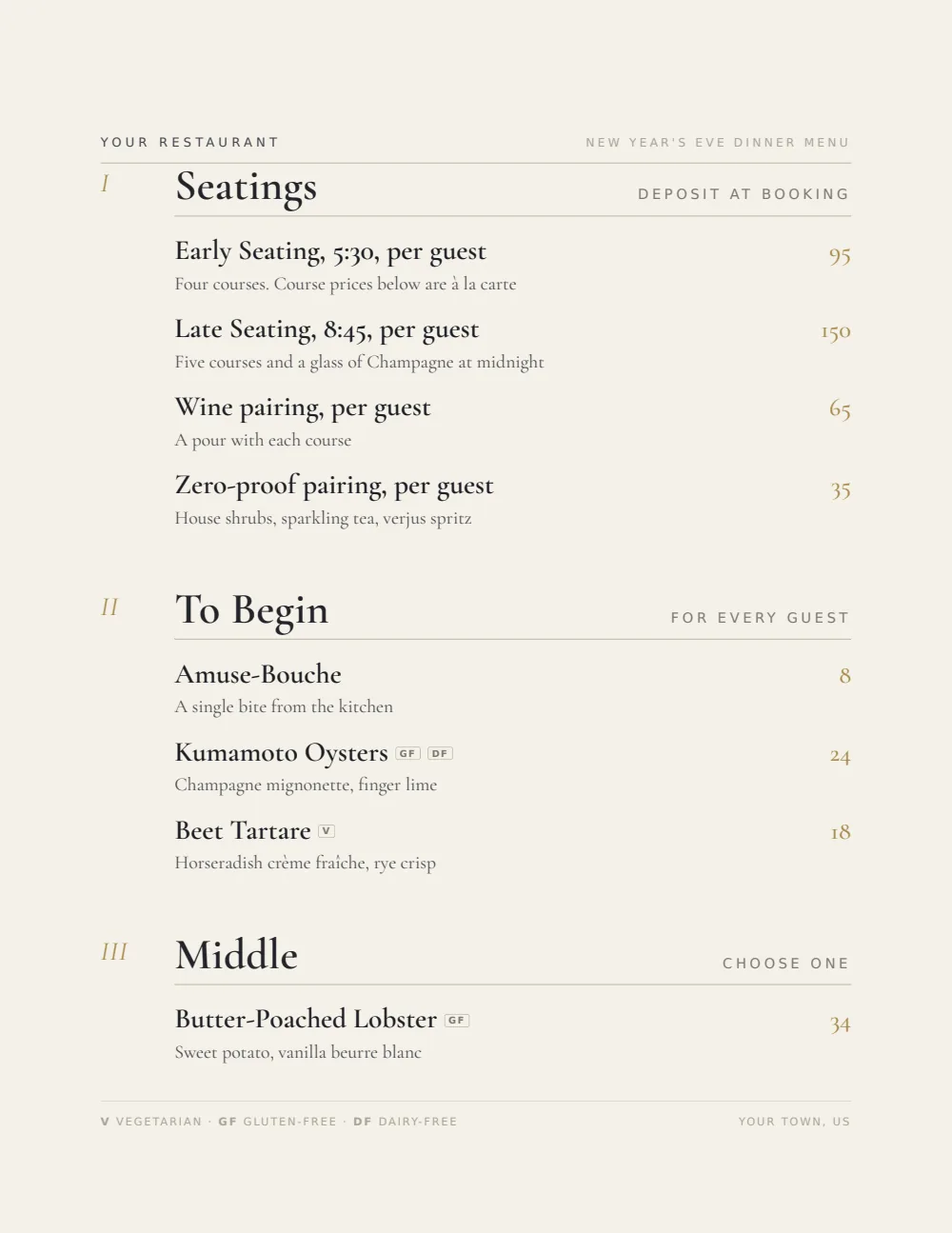
Each seating’s dinner can be its own line with its own price, or one line with two labeled prices (Early, Late). Included courses still carry a number; show the à la carte price with a note under the section heading, or list the courses in the dinner line’s description. Prices run to $9,999, so the big bottles on the special list price like everything else.
What Gaslamp does not do
It does not take New Year’s bookings, deposits, or prepayments, and it does not manage seating times or turns; that is your reservation system. It does not swap the early menu for the late one at 9:00 on its own; you swap the table tents. It does not ring prices into your POS or print the menus for you. It keeps both menus, their codes, and their PDFs current from your phone, right up to 11:55.
The next morning the bar’s January starts. See Dry January for bars.