The date and the clock
Hanukkah 2026 begins at sundown on Friday, December 4, with the first candle, and ends at nightfall on Saturday, December 12. The dates follow the Hebrew calendar, so they move against December every year. In 2026 the first night is a Friday, which is also Shabbat; families who observe it may keep that dinner at home, and your to-go list matters more that night than your dining room.
Hanukkah sits inside the December run: the week after Thanksgiving, alongside the holiday parties, and finished before Christmas. That means the kitchen is already busy. Keep the Hanukkah menu to a short list built on dishes you can make in volume.
The one decision: how much is to-go. A deli or a bakery may sell more latkes by the dozen than on the plate. A dining room may do the reverse. Decide the split and set the to-go order deadline before you post a price.
Timeline: six weeks out to the morning after
These are the Hanukkah steps. The general work of changing a menu is in the seasonal menu changeover checklist.
| When | Kitchen | Bar | Front of house | The menu |
|---|---|---|---|---|
| Six weeks out (late October) | Pick the specials and the to-go list. | Pick a wine or two to suggest with brisket. | Set the to-go order deadline and pickup days. | Add a Hanukkah section and a To go section, hidden. |
| Four weeks out | Cost a latke, a pound of brisket, a doughnut. | Price the suggested bottles. | Start taking pre-orders in your own system. | Show the To go section with prices and the deadline. |
| Two weeks out | Order potatoes, oil, and brisket for the pre-order count plus the dining room. | Order the wine. | Brief staff on the dates and the deadline. | Print the to-go list for the counter. |
| First night (December 4) | Fry in batches all night; latkes do not hold. | Suggest the pairing with the brisket. | Pickups before sundown. | Show the Hanukkah section. |
| Each night | Call the count at lineup. | Nothing new. | Tell tables what is gone. | Hide what runs out. |
| December 13 | Count what sold on which night. | Count the bottles. | Clear the to-go shelf. | Hide both sections. Keep them for next year. |
What to serve
- Latkes. Potato, fried in oil, with applesauce and sour cream. The one dish nobody wants you to change.
- Brisket. Braised, sliced to order, sold on the plate and by the pound.
- Something else fried in oil. Sufganiyot, jelly doughnuts, are the usual one. The oil is the point of the holiday’s food.
- A roast chicken or a fish, for the table that does not want beef.
- A few sides. Kugel, a green salad, roasted carrots.
If your kitchen keeps kosher, you already know the rules; say what applies on the menu. If it does not, do not suggest it does. Latkes served with sour cream next to a brisket are not a kosher meal, and plenty of guests will know.
Lay out the to-go list the way the guest will order it on the phone: the count first, then the item, then the price. “Latkes, one dozen, with applesauce and sour cream.” “Brisket, sliced, per pound.” “Sufganiyot, half dozen.” Put the order deadline and the pickup days in the note under the section heading so nobody has to ask, and list the pickup window as clock times, not “afternoon.” On the first night, when pickups crowd into the hour before sundown, a clear window is what keeps the counter moving.
What to 86 early: latkes on the first night and the weekend nights, because the batter is made in batches and frying cannot catch up once a line forms. Doughnuts, which are baked or fried once a day. What to keep off: anything that competes with the fryer for the whole week.
Pricing: a worked example
This worked example uses made-up costs to price a dozen latkes to go. It is not a benchmark.
| Line | Example cost |
|---|---|
| Potatoes, onion, egg, matzo meal | $3.10 |
| Frying oil (share of the day’s oil) | $1.40 |
| Applesauce and sour cream, 8 oz each | $2.20 |
| Container and lid | $0.90 |
| Cost per dozen | $7.60 |
Labor is the real cost of a latke, so in this example the kitchen prices to-go at a 25 percent food cost: $7.60 ÷ 0.25 = $30.40, printed as $30 a dozen. Brisket by the pound runs the same way from its cooked yield, not its raw weight. The menu item price calculator does the arithmetic for any item.
Print and QR plan
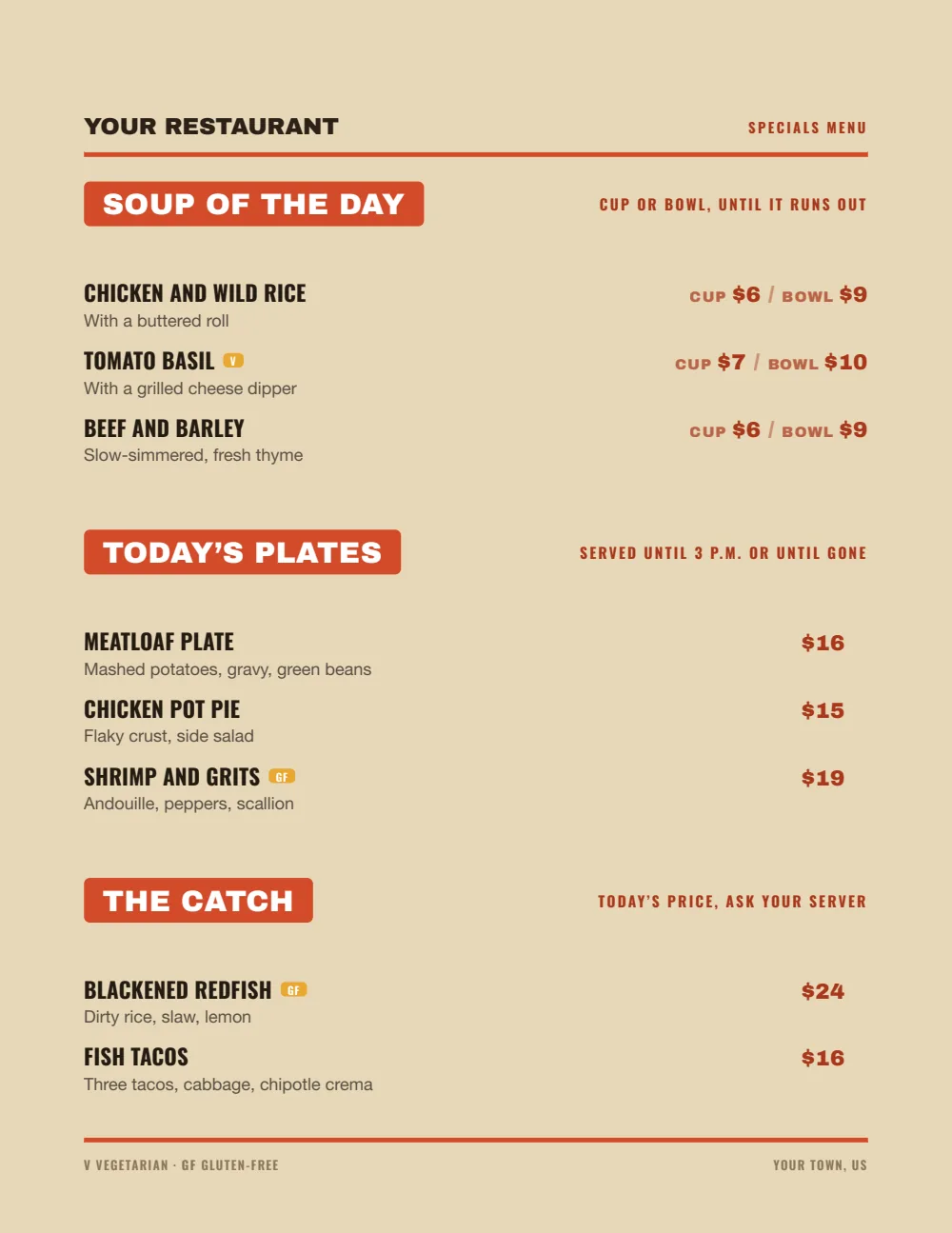
Print the to-go list: a single page at the counter and a stack by the register, with prices, the order deadline, and the pickup days. Print it once pre-orders open, about four weeks out. Do not reprint the dining room menu; eight nights of specials belong on a specials card or a board.
On the QR: add the Hanukkah specials and the To go list as sections on your everyday menu, and show them from December 4 to 12. Customers who scan the code on the table or the window sign see the list without a new code. When the week is over, hide the sections.
What Gaslamp does not do
It does not take pre-orders or payment, and it does not stop taking them at the deadline; that is your phone, your inbox, or your ordering system. It does not show the Hanukkah section at sundown on its own; you show it that afternoon. A dozen and a half dozen can share one line as two labeled prices. It does not certify anything as kosher. It keeps the specials, the to-go list, the QR menu, and the PDF right from your phone, all eight nights.
The holiday parties run the same weeks; see holiday party menus.