The date and the clock
Thanksgiving 2026 is Thursday, November 26. It is the fourth Thursday of November, so it lands on a different date every year, and for plenty of rooms the Wednesday before is a busy night of its own: family is in town and nobody wants to cook the night before cooking.
Guests start asking about Thanksgiving long before November, and the first question is always the price, so the menu and the price have to be settled before the first call comes in. That means a final draft in the first week of November. The menu is truly final when the turkey order is placed, because after that the number of plates you can sell is fixed.
The one decision: one seating or two. One long seating, say 1:00 to 6:00 with tables turning once at most, is gentle on the kitchen and lets guests linger. Two hard seatings, say 12:30 and 4:30, sell more plates but need a menu that fires fast, a timed reset, and a server who can close a table without making the family feel rushed. Pick it now. It decides the rest.
Timeline: six weeks out to the morning after
This is the Thanksgiving-specific calendar. For the general mechanics of changing a menu (costing, recipe cards, every place the menu lives), use the seasonal menu changeover checklist.
| When | Kitchen | Bar | Front of house | The menu |
|---|---|---|---|---|
| Six weeks out (mid October) | Decide seatings. Draft the dishes. Ask the supplier for turkey sizes and a price. | Pick a cider or a punch you can batch. | Decide the booking cutoff and the deposit rule, if any. | Build the Thanksgiving menu as its own menu, hidden until the price is set. |
| Four weeks out (end of October) | Cost one full guest. Test the stuffing and the gravy at volume. | Price the wine pairing, if you sell one. | Open bookings with the price and seating times. | Publish it. Share the QR link in your booking confirmation. |
| Two weeks out | Place the turkey order. That order is your plate count. | Order the cider and the pairing wines. | Close the to-go order form on the Monday before. | Proof it. Print the table copies. |
| The Tuesday before | Brine, stocks, pie dough. | Batch the punch base. | Confirm every booking by phone or text. | Fix any dish that changed, from your phone. |
| Thursday, service | Carve to order or hold? Decide once, early. | Pour the pairing in the order the courses land. | Tell tables what is gone before they order. | Hide what runs out the minute it does. |
| Friday morning | Count what was left. Write it down for next year. | Note what the pairing sold. | Put the regular menu back on the tables. | Hide the Thanksgiving menu. Keep it for next year. |
What to serve, and what to 86 early
A restaurant Thanksgiving menu is a set menu with a few choices, not the everyday menu with a turkey on it. Guests come for the meal they know, cooked by someone else. The usual shape:
- A choice of two or three starters. A soup, a salad, and one richer thing like shrimp cocktail.
- The main: the turkey plate, and one other. Ham or short rib for the table that does not want turkey, and a real vegetarian main, not a plate of sides.
- Sides for the table, family style. Mashed potatoes, stuffing, a green vegetable, sweet potatoes, cranberry, rolls. Served in bowls, they go out fast and read as generous.
- Pie. Pumpkin, pecan, and apple cover almost every table. A sliver of each for a small extra charge sells.
- Children’s price. Half portions of the same dinner, with an age on it.
Pace it for a long table. Sides go out with the main, not after, and pie comes when plates clear, not on a timer. What to 86 early: whatever is cooked in the fewest batches. The second main (the ham, the short rib) usually goes first because the kitchen makes one pan of it. Know the count and tell the floor before service, so a server can say “we have eleven ham left” instead of walking back to the table.
What to keep off: anything that needs a station you are not running. If the fryer is off for the day, the menu should not have a fried dish on it, however good it is in October.
Pricing: a worked example
Price one full guest, not the dishes. The table below is a worked example with made-up costs so you can see the arithmetic. It is not a benchmark; plug in your own invoices.
| Part of the meal | Example cost |
|---|---|
| Starter (average of the three) | $2.60 |
| Main (turkey plate, weighted for the few who pick the other) | $6.90 |
| Share of the sides and rolls | $3.80 |
| Pie slice with whipped cream | $1.40 |
| Waste allowance (carving loss, extra rolls) | $0.70 |
| Plate cost per guest | $15.40 |
At a target food cost of 27 percent in this example, $15.40 ÷ 0.27 = $57.04, which rounds to $58. A children’s price at half portions runs the same way: about $7.70 of food, ÷ 0.27 = $28.52, printed as $28. The wine pairing is priced on its own line so a guest who does not drink does not pay for it. The menu item price calculator does the division and the rounding for you.
Print and QR plan
Print the Thanksgiving menu for the tables: this is a meal where a paper menu at every place still feels right, and a family of eight passes it around. Print once the turkey order is in, two weeks out, and print a few spares for the host stand. Keep the price per guest on the first line so nobody has to ask.
On the QR: give Thanksgiving its own menu with its own code, and put that link in every booking confirmation so guests can read it ahead. Your everyday menu and its code stay exactly as they are on the tables through Wednesday; on Thursday the Thanksgiving tent goes out and the everyday one goes in a drawer until Friday. If you run a to-go pie and sides list, it can be a section on the Thanksgiving menu with the pickup day in the note under its heading.
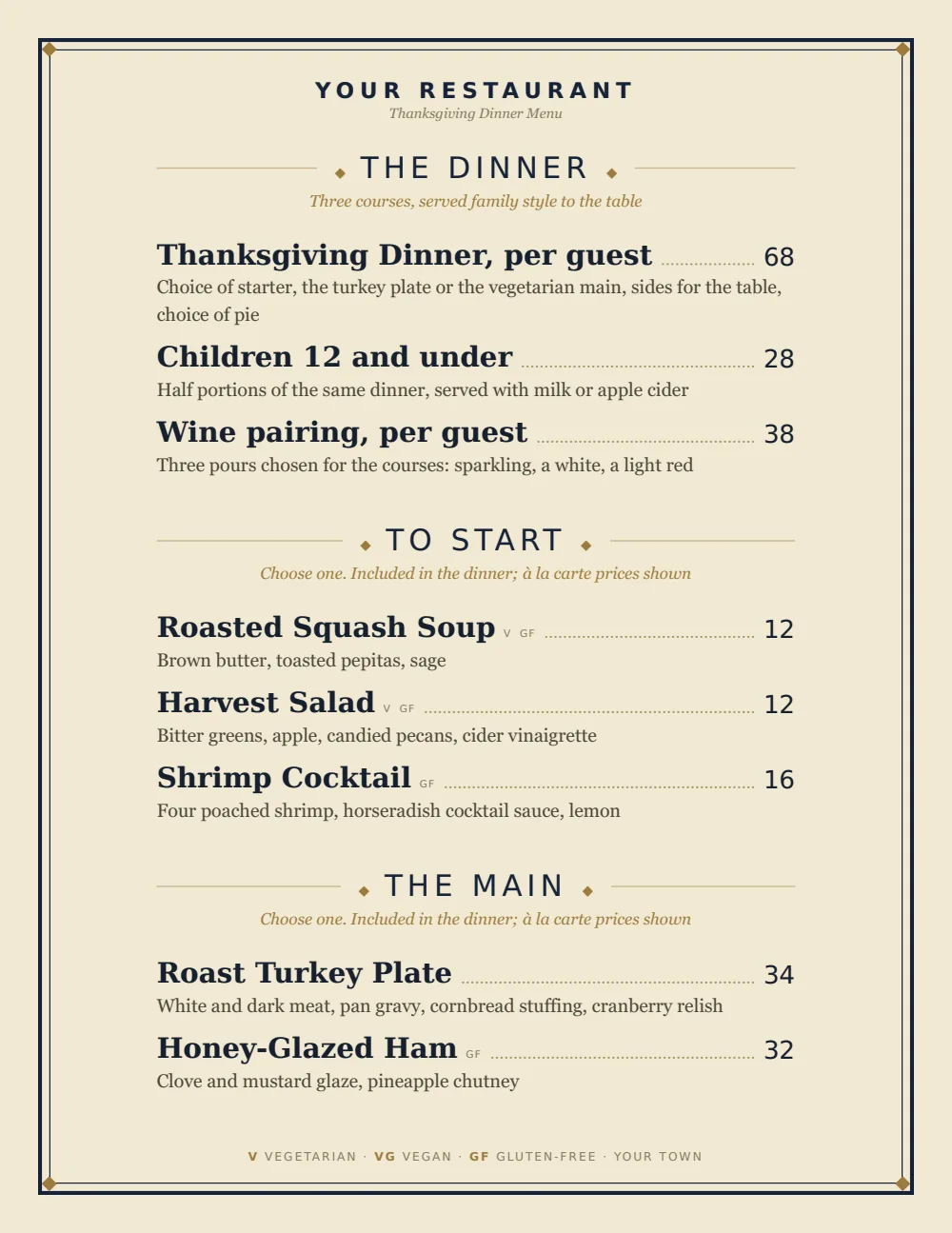
In Gaslamp, the per-guest dinner is one line at its price, and the children’s price can sit beside it as a second labeled price, with the courses listed underneath. Every line carries a number, so the choices under each course show their à la carte price with a note under the section heading that they are included in the dinner. If you would rather not show those numbers, list the choices in the description of the dinner line instead.
What Gaslamp does not do
Gaslamp is menu software. It does not take reservations, collect deposits, or cap covers per seating; keep those in your booking system. It does not switch the Thanksgiving menu on and off by itself at a set time; you show it Thursday morning and hide it Friday, from your phone. It does not talk to your POS, so the Thanksgiving price has to be rung in there too. And it does not print or ship: download the PDF and print it in house or at a shop.
Thanksgiving is the first of the big December run. The holiday party playbook starts the day after.