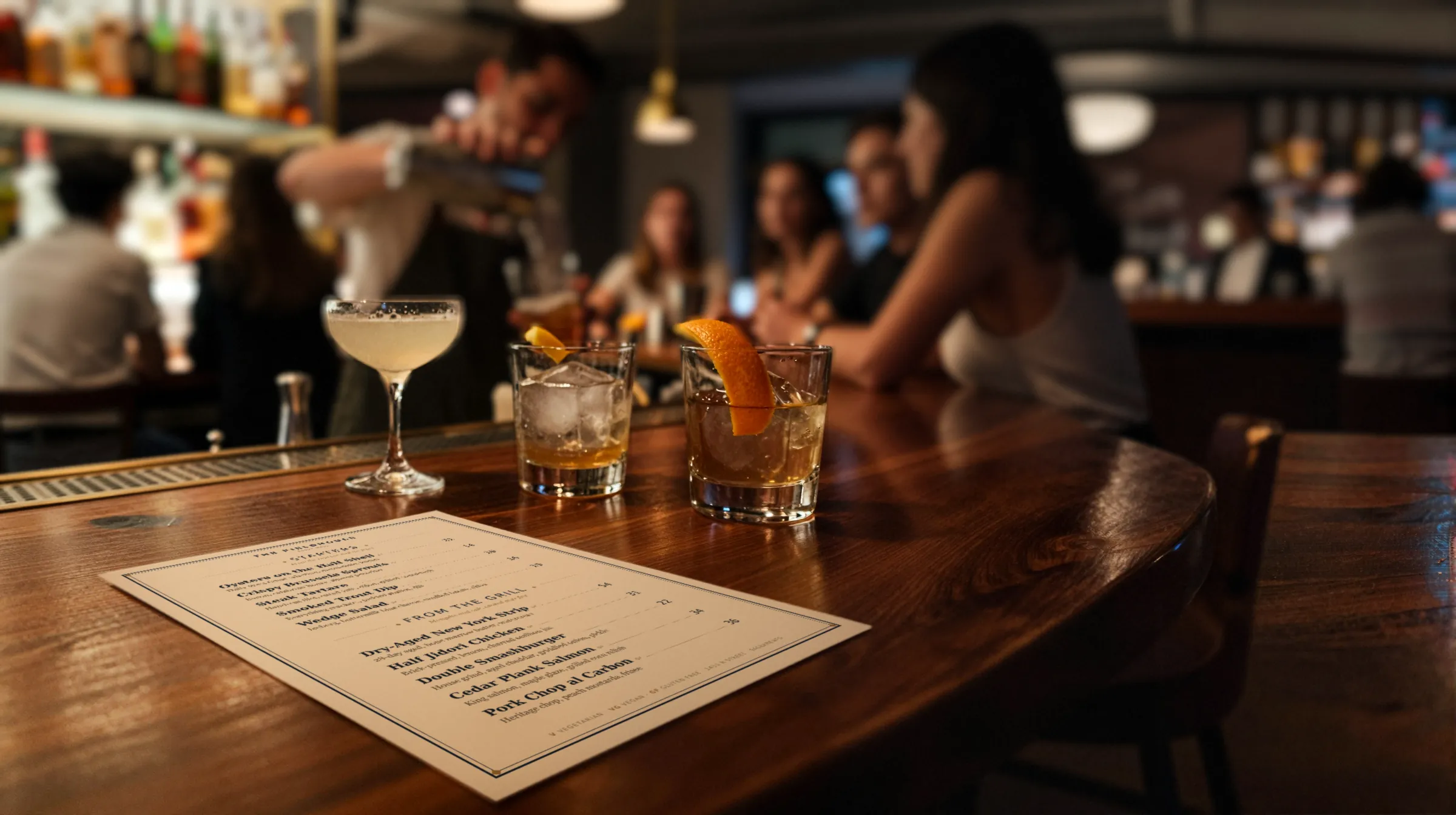
What happy hour is for
Happy hour fills the slow stretch between lunch and dinner with people who would otherwise go home. A happy hour menu has two jobs: get people through the door in that window, and give them a reason to stay for a second round or a plate of food at full price. Everything on it should serve one of those jobs, and it should cost the kitchen as little extra work as possible.
That means short. A happy hour menu with twenty items is a second dinner menu at a discount, run by a kitchen that is trying to set up for dinner at the same time.
Before you write a single item, settle three things with the bar and the kitchen: the days and hours, where it applies (bar only, bar and patio, or the whole room), and who is on shift to run it. A happy hour that the kitchen only learns about when the first ticket prints will be slow, and a slow happy hour is worse than none.
Happy hour menu ideas that work at five o’clock
The rule for every item is the same: it comes out fast, from one station, using prep that already exists. These are the items bars lean on, and why.
| Item | Why it works | Watch for |
|---|---|---|
| Draft beer | Low pour cost, no prep, fast. | Pick one or two taps, not the whole wall. |
| House red and white by the glass | Opened bottles move before they turn. | Name the grape and producer, not just “house”. |
| Well drinks or one batched cocktail | A batch keeps the bartender quick at the rush. | Price it so the full-price cocktails still sell. |
| Fries or chips with a house sauce | Low plate cost, pairs with everything. | Fryer space when dinner starts firing. |
| Sliders or a half portion of a starter | Uses dinner mise, feels generous. | Portion creep; spec the weight. |
| Oysters, if you already shuck | A classic draw at the bar. | Only if a shucker is on at five. |
Happy hour pricing
Discount what already earns. Draft beer, house wine, and well drinks carry a pour cost low enough that a dollar or two off still leaves real margin. A cocktail made with a premium spirit does not. Price the food the same way: start from the plate cost and make sure the discounted price still clears it with room to spare. The menu item price calculator does that math in a minute.
There is a rule of thumb you will hear behind a lot of bars: happy hour pays when the guest orders a second drink or some food. A guest who has one discounted beer and leaves cost you a seat, a server’s attention, and a glass to wash. Build the menu so that the second drink and the snack are easy to say yes to, and keep a few full-price items in view for the guests who stay past six.
- Use a flat amount or one price point. “$8 cocktails” is easier to read and ring than a list of different discounts.
- Leave the bestsellers alone. If a dish sells at full price at seven, it does not need a discount at five.
- Write the end time on the menu. Guests who know when it ends order before it ends.
Check your state’s rules first
Rules on happy hour drink specials vary by state, and sometimes by city, in ways that change the menu. North Carolina is a clear example of a strict one. Its ABC Commission says permitted establishments may offer happy hour food specials only, and its rule says a drink cannot be sold at a reduced price for any period shorter than one full business day. It also bans advertising “2 for 1” and any promotion that requires buying more than one drink.
Other states have their own versions, and some cities add rules on top. Before you write a drink special on anything a guest can see, read your state alcohol regulator’s guidance or ask your licensing contact. In North Carolina, food specials are the part that is allowed; do not assume your state treats them the same way.
How to show happy hour on a QR code menu
Put happy hour in its own section of the main menu rather than a separate menu. The section heading says “Happy hour”, and the subtitle under it carries the rules in one line, up to 120 characters: “Monday to Friday, 4 to 6 p.m., bar and patio only.” Guests read the hours before they read the prices, and nobody argues with the server about it at ten past six.
- Build the section once, with each happy hour item at its happy hour price.
- At the start of the window, switch the section on and tap Save & update live menu.
- At the end, switch it off and save again. The items stay saved for tomorrow.
Gaslamp has no timer and no scheduled menus. Someone has to flip the switch twice a day, and it helps to make that one person’s job at the same moment they set the bar. If you would rather keep one list, you can also change a single price at four and back at six, as the drawing above shows. Either way, the menu behind your QR code catches up about thirty seconds after you save.
A printed happy hour card
Whatever you print, print the rules with it. The days, the hours, and where it applies belong in large type at the top, because that is the first thing a guest asks and the first thing a new bartender gets wrong. If a special is food only because of your state’s rules, say “food specials” plainly so nobody expects a cheap round.
On the bar top, a small printed card still does a lot of work: it sits where people stand and it can carry the hours in large type. If your happy hour list rarely changes, print it once on heavy stock. If it changes weekly, keep the card to the hours and a line that points to the QR code, and let the hosted menu carry the items and prices. More in QR code drink menus, and see how bars run it at cocktail bars and taprooms.