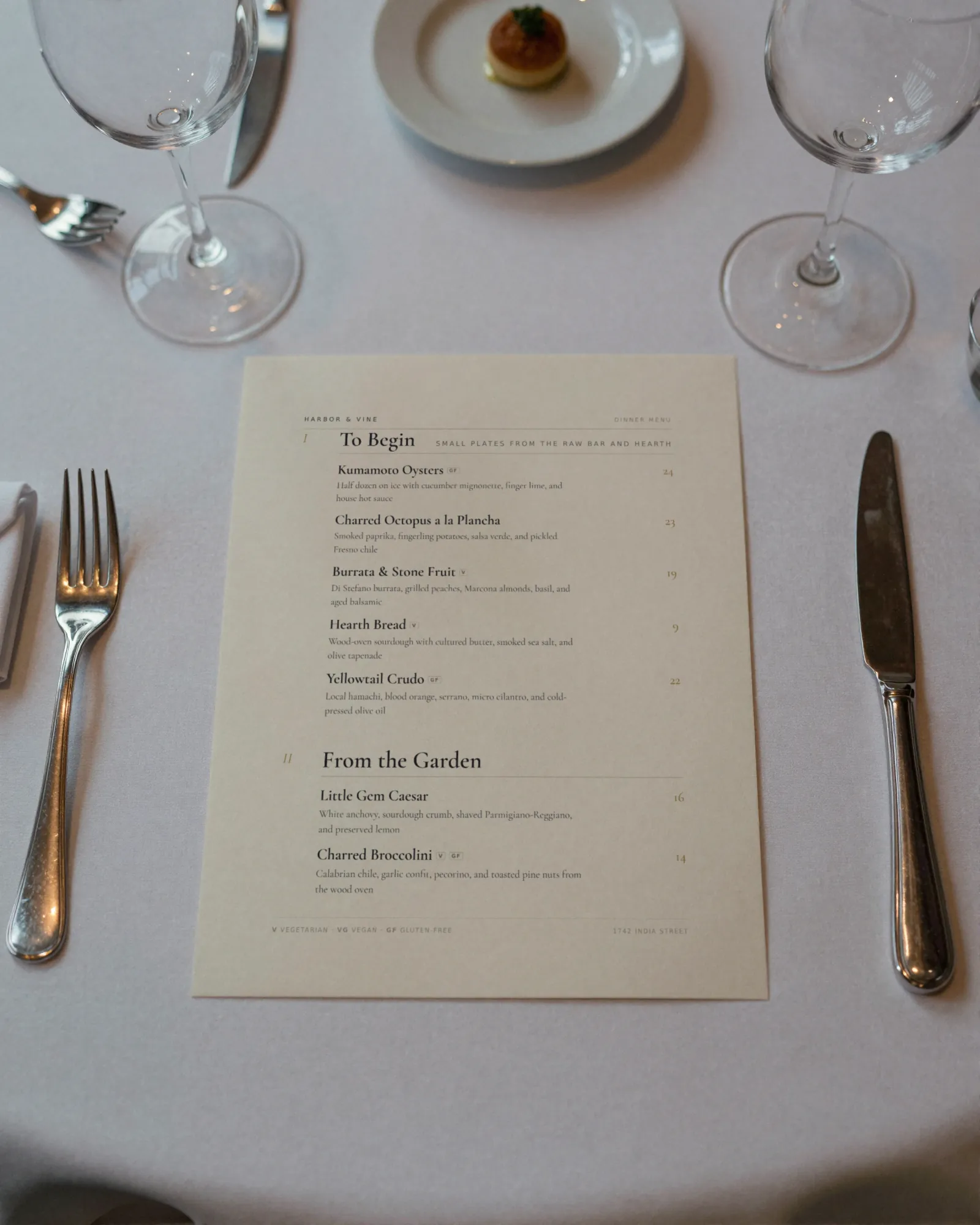
Prix fixe, tasting menu, and table d’hôte
The words get used loosely, so it helps to be clear about what you are writing before you write it.
| Format | Courses | Guest chooses | Where you see it |
|---|---|---|---|
| Prix fixe | Usually two to four | One dish per course from a short list | Bistros, holiday menus, pre-theater, restaurant weeks |
| Tasting menu | Often five or more, smaller portions | Nothing, or a short or long version | Fine dining, chef’s counters, pop-ups |
| Table d’hôte | A set meal | Little or nothing | The older name; still used in some hotels and French rooms |
All three share one idea: the guest agrees to a price before the food arrives, and the kitchen agrees to a sequence. That makes the kitchen’s night more predictable, and it makes the menu’s job simpler. It does not have to sell each dish; it has to make the whole meal clear.
How to structure a course menu
- Pick the course count. Three is the classic prix fixe (first, main, dessert). A tasting menu is set by what the kitchen can pace across the room, not by a number that sounds impressive.
- Decide the choices. Two or three per course on a prix fixe. More than that and you are running an à la carte menu with a fixed price, and the kitchen stocks for all of it.
- Balance the weight. Heavy main, lighter first course, a dessert that does not need a nap afterward. On a tasting menu, place the richest dish two thirds of the way through.
- Plan the supplements. Anything that costs far more than the rest (caviar, a large truffle shave, a premium cut) goes as a priced supplement rather than into the base price.
- Plan the drinks. A wine pairing, and a non-alcoholic pairing if you offer one, each as a separate price.
Label the courses in order. Words (first, second, third), or roman numerals (I, II, III) if the room is formal. Guests use the labels to follow along, and servers use them to call the next course.
How to write a prix fixe menu: one price, courses in order
The price appears once. Do not repeat it on every dish, and do not print dish prices on a prix fixe unless the same dishes are also sold à la carte. Each dish gets one short line: the main ingredient and what is done to it. The guest is choosing between two or three things, not reading a paragraph about each. For description craft, see how to write menu descriptions.
On a QR menu, the cleanest version is one priced line for the whole meal with the courses in its description. For example, an item called “Three courses” at 68, described as: “First: chicories, anchovy, lemon, or chilled pea soup. Main: halibut, brown butter, or lamb shoulder, white beans. Dessert: olive oil cake or cheese.” That reads in one breath and leaves no doubt about what the price buys.
Supplements and wine pairings as priced lines
A supplement is an honest way to offer something expensive without raising the price for everyone. List each one on its own line with its own price, near the course it belongs to or in a short Supplements section after the courses:
- Caviar service, 45
- Shaved black truffle on the risotto, 30
- Cheese course before dessert, 18
- Wine pairing, five glasses, 85
- Non-alcoholic pairing, 45
The numbers are illustrative; price your own from cost. When the caviar runs out halfway through service, switch that line off so nobody orders what the kitchen cannot send.
Tasting menus in Gaslamp, whatever the price
Gaslamp prices every item from $1 to $9,999, and every item must have a price. A tasting menu at 245 per guest is one line at 245, and a menu offered in two lengths can carry both on that line as labeled prices (Five courses, Nine courses). Then:
- Write the course count and the nights in the note under the section heading (up to 120 characters): “Tuesday to Saturday, last seating 9:00.”
- Put the pairings and supplements in that section as priced lines of their own.
- Because every item needs a price, the courses themselves cannot be listed as unpriced lines. Name the progression in the tasting line’s description, present it at the table, or print a course card for the night.
That last one is a real limit and the workaround is not perfect. We would rather say so here than have you find it on a Friday.
Dated menus that change nightly
A menu that changes often should carry the date. It tells the guest the food is today’s, and it tells the team which version is on the table. Put the date in the section subtitle or at the top of the printed card. Many tasting rooms print a fresh card every night and send it home with the guest.
In Gaslamp, change the dishes and the date from your phone, tap Save & update live menu, and the menu behind your QR code shows tonight’s version about thirty seconds later. When a guest asks what they had last Thursday, that menu is still in version history (the last 50 saves), ready to restore. On a paid plan you can also download a print-ready PDF for the night’s card. See how this works for fine dining and for pop-ups and supper clubs, where the menu is new every event.
A prix fixe course menu template
Copy this shape and fill in your own dishes and prices.
- Heading: Prix fixe
- Subtitle: Three courses · Tuesday, October 6 · last seating 9 p.m.
- Line: Three courses, 68. Description: First: two choices. Main: two or three choices. Dessert: two choices.
- Line: Wine pairing, three glasses, 42
- Line: Cheese course supplement, 16
- Menu disclaimers: your allergy notice, and any rule about the whole table ordering the menu together (the hosted menu always shows this field; in print, just two of the eight designs include it)
A description can run up to 300 characters, so write each choice as a short phrase. If the choices will not fit, the menu has too many of them. For printing the nightly card, see the restaurant menu printing guide.