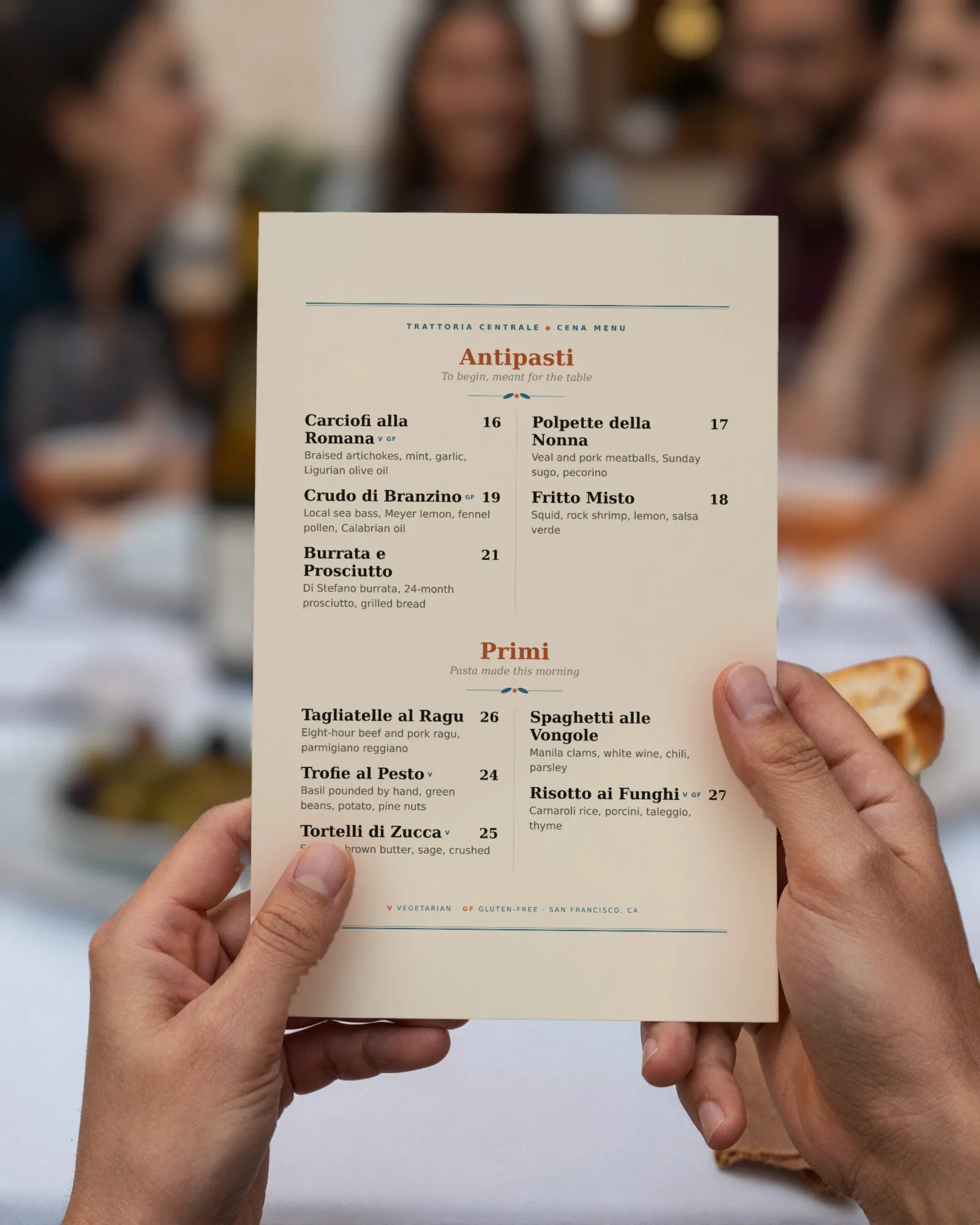
What a menu description is for
A guest reading your menu is trying to answer one question per line: will I like what shows up? The dish name gets them halfway. The description finishes the job. It is not the place to prove the kitchen can write; it is the place to stop the guest from waving the server over to ask what “the Garden” is.
Good menu item descriptions also do work on the floor. A server can read them aloud at the table, a new hire can learn the menu from them, and the kitchen can check the plate against them. If the description and the plate disagree, the description is wrong.
Name the things that change the decision
Most dishes need three pieces of information, in this order of importance:
- The main ingredient and how it is cooked. “Pork shoulder, braised” tells a guest more than any adjective. Method is the fastest cue to texture: grilled, fried, braised, raw.
- The two ingredients that matter. Not all eleven. The ones that make this dish different from the one down the street, or that a guest might love or avoid: the chili, the blue cheese, the anchovy.
- Origin, when it is true and it means something. A named farm, a region, a style (“Detroit-style”). Leave it out if you cannot say where the thing came from this week.
Sides, sauces, and garnish go in only if a guest would care. “With fries” matters. “Microgreens” usually does not.
Before and after: food description examples
These rewrites are ours, written for this guide, on the kinds of dishes most menus carry. The pattern is the same each time: drop the praise, keep the facts, add the one detail a guest needs.
| Before | After |
|---|---|
| Our famous burger, made with love and the freshest ingredients, served with your choice of side. | Two smashed beef patties, American cheese, pickles, onion, griddled bun. Fries or salad. |
| A delicious pasta dish featuring a rich and creamy sauce that will leave you wanting more. | Rigatoni, pork sausage, tomato cream, chili flake, parmesan. |
| Fresh catch of the day, perfectly prepared by our chef. | Grilled halibut, white beans, lemon, olive oil. Ask your server what came in today. |
| Mouthwatering wings tossed in our signature sauce. | Fried chicken wings, sweet chili glaze, sesame, scallion. Contains sesame. |
| A garden-fresh salad bursting with seasonal flavors. | Little gem, shaved radish, toasted walnuts, buttermilk dressing. |
| Our decadent chocolate dessert, a must-try! | Flourless chocolate cake, salted caramel, whipped cream. Gluten-free. |
Notice what the rewrites add: the fish has a method, the wings name their allergen, the salad names the nuts. Notice what they drop: “signature,” “famous,” and “made with love,” which every guest has read on every menu and none has believed.
Get the dish name right first
The name does half the work, so fix it before the description. A name should tell the guest what the dish is, not what the kitchen calls it at the pass. “The Garden” and “Chef’s Favorite” tell a guest nothing; “Roasted carrots, harissa, yogurt” tells them nearly everything, and then the description can be short or empty.
House names are fine for dishes guests already know, a burger with a name regulars ask for by name, or a cocktail list where the name is part of the fun. In those cases the description carries the facts: spirit first for a drink, then the two things that change it. Keep the style consistent inside a section. A list where half the dishes have clever names and half have plain ones reads as two menus stapled together.
What to cut
- Praise. Delicious, mouthwatering, decadent, perfectly, lovingly. The guest decides that.
- “Fresh” on its own. Every kitchen says it. Say what makes it fresh (“picked this morning”) or leave it out.
- The obvious. “Served hot.” “On a bun,” for a burger. “A classic.”
- Claims the kitchen cannot back. “House-made” on a bought-in dessert, a farm name from last season, “local” when the truck came from three states away.
- Full ingredient lists. The line cook needs them. The guest needs two.
How long a menu description should be
One line is right for most dishes: roughly six to fifteen words. Signature dishes and anything unfamiliar can take two. If the whole menu runs to three lines a dish, the guest stops reading descriptions and starts reading prices.
Match length to the kind of place. A fast-casual board or a taqueria menu often needs no descriptions beyond the filling. A fine dining menu may list only three ingredients per course, set in a line. A bar menu describes cocktails by spirit, then the two things that change the drink.
In Gaslamp, a description is either empty or between 10 and 300 characters. Treat 300 as the ceiling. Long descriptions push the dishes below them down the page and make the printed menu tighter.
Allergens in the description
The description is where a guest first finds out what is in a dish, so it is the place to name any major allergen they would not expect: tree nuts in a romesco, sesame in a dressing, fish sauce in a salad, egg in a mayonnaise-based sauce. Put it at the end (“Contains sesame.”) so it is easy to find. Obvious ones (“shrimp” in a shrimp cocktail) do not need repeating.
That is not a full allergen program, and it does not replace the server asking. Rules vary by state and city, so check your local requirements. Restaurant allergen labeling covers the nine major allergens and what to print.
Writing and fixing descriptions in Gaslamp
Each dish in Gaslamp has a name, a description, a price, and dietary tags. Start from the sample menu in your design and work through the descriptions in the editor, which runs in a phone browser, so you can rewrite them at the pass while reading the plate. Each description is either blank or 10 to 300 characters.
Tap Save & update live menu, and the new wording is on the phone menu about thirty seconds after you save. The last 50 versions stay in history, so an old description is never lost. Gaslamp does not write descriptions for you; the words are yours. For the rest of the menu, see how to make a restaurant menu and restaurant menu design.