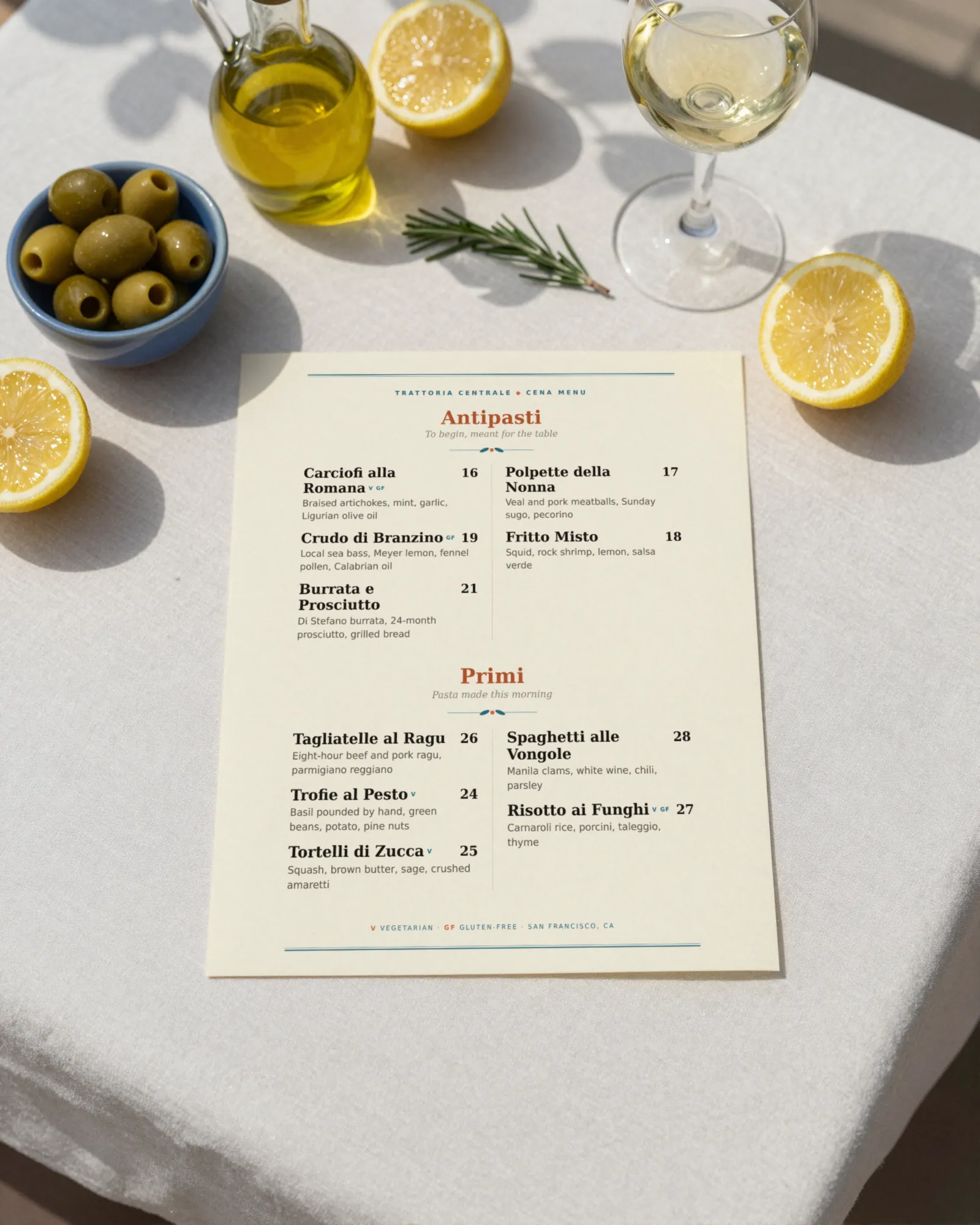
Start with the plate cost
Every menu pricing strategy rests on one number most kitchens have not updated since opening: what it costs to put the dish on the plate. Cost it recipe by recipe at this month’s invoice prices. Include everything that leaves the pass: the protein, the starch, the sauce, the garnish, the bread and butter that goes with it, the fry oil, and the trim you lose when you portion.
Write the date next to each plate cost. A cost from last spring is a guess, and every decision below inherits the error. If you only have time to cost a few dishes, cost the ones that sell the most and the ones with the most expensive protein.
Restaurant pricing methods, side by side
There are three ways operators price a menu, and most good menus use all three: one to get a starting number, two to correct it.
| Method | The math | Where it goes wrong |
|---|---|---|
| Food cost percentage | Plate cost ÷ target percentage. A $4.20 plate at 30 percent is $14. | Underprices cheap dishes and overprices expensive ones. |
| Contribution margin | Price minus plate cost, in dollars. Set a dollar floor per plate. | Can push a pasta to a price the room will not pay. |
| Market check | What comparable places nearby charge for the same dish. | Copies someone else’s costs and rent, not yours. |
The food cost method is where to start because it is fast and it scales. A commonly quoted target for full-service kitchens is somewhere from the high 20s to the mid 30s percent, with drinks running lower. That is a rule of thumb, not a standard; your rent and labor decide your number. The menu item price calculator does the division and shows the percentage you actually land on after rounding.
Contribution margin: the dollars that pay the rent
A percentage does not pay anyone. Dollars do. A steak at 38 percent food cost can leave $22 on the table, while a pasta at 20 percent leaves $14. If you price everything to the same percentage, your cheapest dishes end up too cheap and your expensive ones too dear, and guests drift toward the cheap ones.
So after the percentage gives you a starting price, look at the dollars. Many kitchens let expensive proteins run a higher percentage to keep the price sane, and let low-cost dishes like pasta, grain bowls, and flatbreads run a lower percentage to carry more of the margin. For sorting the whole menu by sales and margin together, see menu engineering.
Rounding, price endings, and the dollar sign
Nobody prints $13.93. Menus round, and the ending you choose says something about the room. These are trade habits, not rules:
- Whole dollars. The norm for full-service dining rooms. Clean to read and clean to say at the table.
- .50 steps. Useful at counters and cafés, where many prices sit under ten dollars and a full dollar of rounding is a large percentage.
- .95 or .99. Reads as retail. Fine at a counter or a grab-and-go case, odd on a dinner menu.
Round up, not to the nearest. Rounding down on a busy dish costs you on every plate. Whichever ending you pick, use it across the whole menu so no single price looks like it was bargained over.
On the dollar sign: a 2009 Cornell study run with the Culinary Institute of America tested three price formats on 201 diners at the CIA’s café in Hyde Park. In that study, guests whose menus showed plain numerals with no dollar sign spent about 8 percent more on average than guests whose menus used the dollar sign, and prices spelled out in words did no better than the dollar sign. It is one study of 201 guests in one café, so treat it as something to try on your own menu, not a law.
When to raise menu prices
Raise when the numbers tell you to, not when you finally have time to reprint. The usual triggers:
- A key cost moves and stays moved. If beef, eggs, or cooking oil is up for more than a few weeks, it is not a blip. Re-cost the dishes that use it.
- A dish has drifted past target. Run the plate costs every quarter. Anything well past your target percentage needs a price, a portion, or a recipe change.
- A scheduled review. Many operators look at the whole menu once or twice a year, often at a seasonal changeover.
Raise a few dishes at a time, not everything by the same amount. Guests notice the price of the dish they order every week far more than a new price on something they have never tried. If you do need a flat increase across the menu, the menu price increase calculator applies a percentage to every line and rounds each one the way menus do.
Test a price on the QR menu before you reprint
Paper makes every price change expensive, so operators tend to change prices rarely and all at once. A hosted menu behind a QR code lets you change one price, watch what happens, and only then commit it to paper.
- Change the price in your POS and on the hosted menu the same day.
- Watch that dish’s sales for two or three weeks against a similar period before the change.
- If it holds, keep it. If it drops off, put the old price back.
- When the prices have settled, print the new paper menu once.
One catch. If paper menus are also on the tables, the paper and the QR will disagree until you reprint. Either charge the lower of the two until then, or run the test in the part of the house where the QR is the only menu, like the bar or the patio.
What Gaslamp does with a price
Gaslamp does not set your prices. It has no POS connection, no sales data, and no plate costs. The math is yours; the free calculators on this site help with it.
Gaslamp is where the price changes. The editor runs in your phone’s browser (or a laptop) with a number keypad for prices, and each item holds a price between $1 and $9,999, or up to three labeled prices for sizes. After you save, a guest scanning your QR code sees the new number about thirty seconds later. If a test price does not hold, restore the earlier version from history; Gaslamp keeps the last 50. When the prices have settled, download a print-ready PDF on a paid plan and reprint. More on the whole routine in how to update menu prices without reprinting.