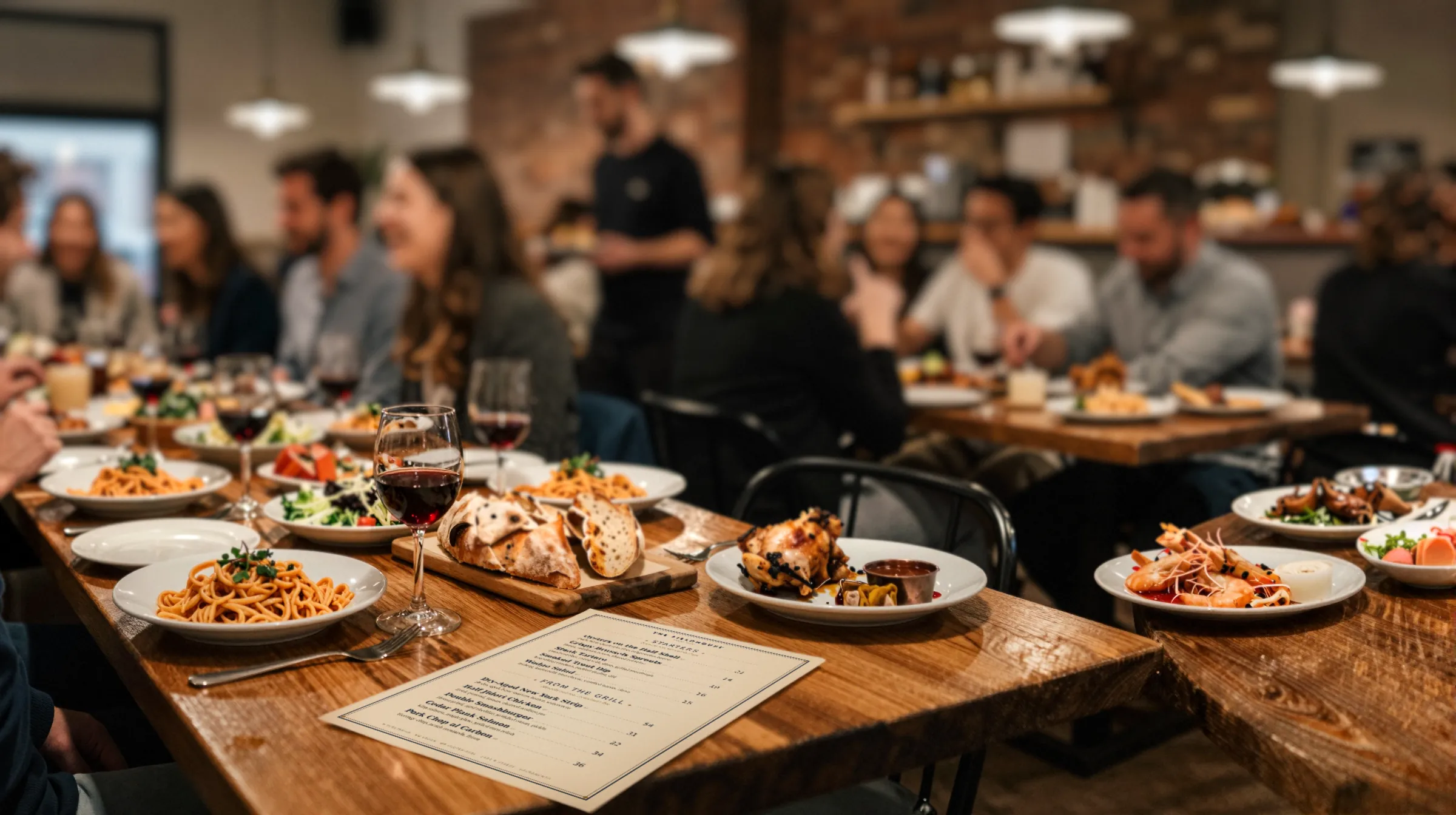
The number is a kitchen question
People ask how many items a restaurant menu should have as if there were a correct figure. There is not one we can honestly give you, and we have not found research that settles it for every kind of place. What there is instead is a set of limits you can measure in your own kitchen, and the menu size is wherever the first of them bites.
Start with the prep list. Every dish brings its own mise en place: sauces, cut vegetables, portioned proteins, garnishes. Write the prep for each dish, add up the hours, and compare that with the hours your prep cooks actually have before service. If the list does not get finished on a normal day, the menu is too big for the kitchen you have, however good each dish is.
Then count storage. Every dish needs its components somewhere: the lowboy under the station, the walk-in, dry storage, the freezer. When the reach-ins are packed so tight that cooks dig for the right sauce during service, the menu has outgrown the line. Adding a dish is easy on paper and hard in a lowboy.
Waste lives in the dishes nobody orders
Every ingredient that appears in only one dish is a bet. If that dish sells a few times a week, most of the case goes in the bin, or it gets used past its best and the dish gets worse, which sells it even less. A long menu multiplies these bets.
Look for cross-use. A menu of twenty dishes built from a shared set of proteins, sauces, and vegetables can carry less waste than a menu of twelve where every dish needs its own ingredients. When you are deciding whether a dish stays, ask what else its ingredients feed.
Ticket times and the line
Count dishes per station, not per menu. A menu with thirty items can run fine if they spread across grill, sauté, fry, and garde manger. A menu with fifteen can fall apart if eleven of them land on one cook. On your busiest night, watch which station the tickets wait on. That station is setting your menu size.
Long menus also slow the dining room. Guests take longer to decide, servers field more questions, and the first order goes in later. On a night with two turns, that time comes out of the second seating.
Consistency suffers too. A cook who makes a dish forty times a night makes it the same way every time. A cook who makes it twice a week is working from memory and the recipe card. The more dishes on the menu, the more of them fall into that second group.
How guests read a menu in a dim room
A guest reads your menu at a table with low light, a conversation going, and a server who will be back in a minute. Every extra dish is one more line to read before they decide. When the list is long, some guests stop reading and order something they recognize, which is rarely the dish you most want to sell.
A menu that fits on one side of one page, in type large enough to read by candlelight, is easier on everyone. If yours needs a smaller font to fit, that is the menu telling you something. The same holds on a phone: a hosted menu with twelve sections is a long scroll with a thumb. There is more on layout in restaurant menu design.
When a long menu works
Some places run long menus on purpose and do it well. They share a pattern: many dishes, few components.
- Taquerias. Eight fillings times tacos, burritos, and plates is a long list from one prep.
- Diners and brunch. Eggs, potatoes, bread, and pork in many arrangements.
- Bars and taprooms. A long drink list costs little to hold; the food menu usually stays short.
- Cafés. A drink menu with sizes and milks is long on paper and short in the prep.
How to cut a menu that has grown
Menus grow by addition. A regular asks, a special sells well, a supplier offers something, and nothing ever comes off. Once or twice a year, go through every dish with your POS sales report and your prep list side by side.
| Signal | What it suggests |
|---|---|
| Sells rarely, uses ingredients no other dish uses | Cut it, or make it a special on the days you have the product. |
| Sells rarely, shares ingredients, earns well | Keep it, move it higher in its section, and rewrite the description. |
| Sells well, slows one station | Rework the prep or move part of it to another station. |
| Two dishes a guest cannot tell apart | Keep the better seller. |
| A regular’s favorite that nobody else orders | Hide it and let staff know it can be made on request, if the kitchen can. |
If you want to put numbers on it, menu engineering sorts every dish by popularity and margin, and the menu item price calculator works out what each plate earns.
Gaslamp’s ceiling: 12 sections of 20
A Gaslamp menu holds up to 12 sections of 20 items each. That is far more than most kitchens should run, so treat it as a ceiling, not a goal. If you hit it, the fix is usually to split food and drinks into separate menus (paid plans allow more than one), not to squeeze.
Cutting in Gaslamp is gentle. Switch a dish off and it leaves the hosted menu about thirty seconds after you save, but it stays in the editor, so you can bring it back for a weekend or a season. Version history keeps the last 50 versions. Gaslamp does not read your sales, so the decision of what to cut is yours; it only makes the change quick. For the whole process of building the menu, see how to make a restaurant menu.